SpaceChem is an indie puzzle game which draws its theme from real chemistry in a sci-fi universe, using aspects of programming as the basis for puzzle solutions. A single puzzle is about transforming molecules that come into your reactor on the left into the required molecules that are output on the right. To accomplish this you set up a route with instructions for tiny robots (Waldos) to follow. There's never only one solution - in fact the greatest strength of the game is that you know for any one puzzle you could be designing a solution that the creators never thought of. As such it's much more of a creative game than a typical on-rails puzzle game (like much of Portal 2).
The puzzles start out simple as you get to grips with the basic mechanics of the game or whenever a new instruction is added for you to use. Even these simple puzzles can be really fun as you can try optimize your solutions to achieve the best solutions globally or amongst your friends. You can see an example of this in my earlier post where I tackled Best Left Unanswered (level 8 of more than 50 in the base game) to try and match the best solutions. It's a good example of the game's mechanics and the thought processes that can go into solving a level, so I'm not going to repeat it - just go read it if you're interested.
However, what should be evident from the (cropped) screenshot above is that this isn't a pretty game. The interface is straightforward and functional, but don't expect the production values of a triple-A title. The story, such as it is, is told through (occassionaly funny) pages of text. What you have instead is a game whose prime focus is on challenging you with its excellent puzzles and nothing gets in the way of that.
Which brings me to my only real problem with this excellent game - the different types of levels. They are research, production and defence. Research levels are the simplest: a single reactor with two input areas and two output areas.
Production levels allow you to combine reactors to allow for advanced tasks, and may involve three or more inputs and outputs.
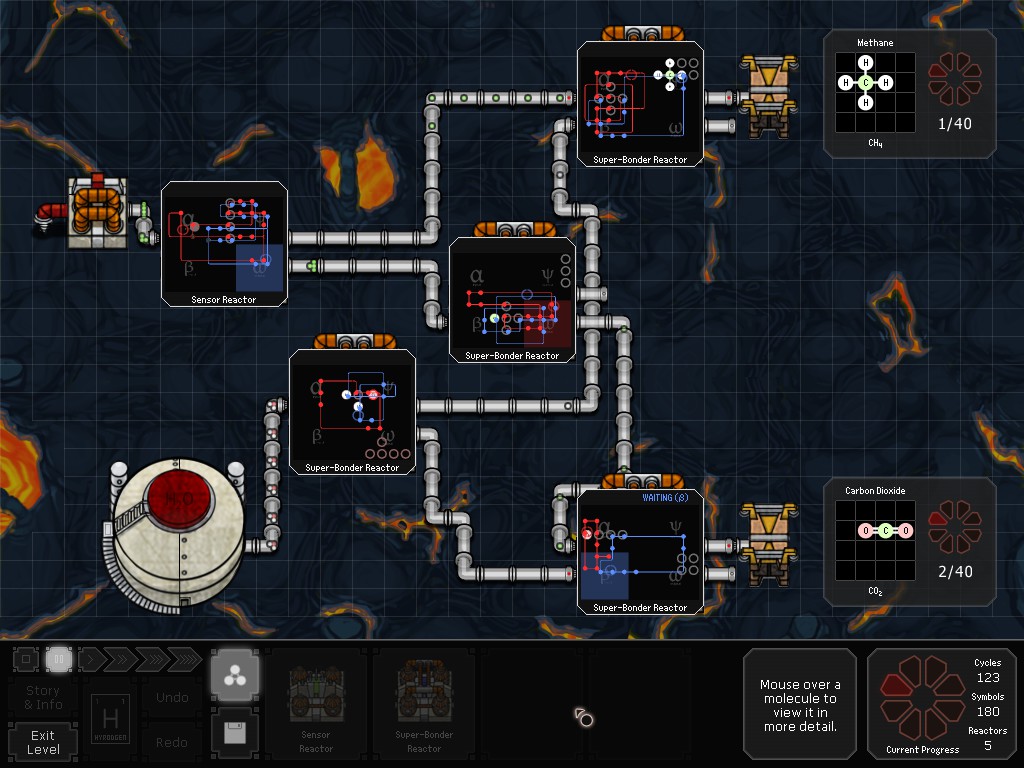
Defence levels are like production levels but always include a gimmick which allows you to turn your chemicals into a way to defeat the monster of the week.
Research levels are tightly focused puzzles which require only one or two bursts of inspiration to figure out and advance. Production levels and defence levels aren't necessarily more difficult than research levels, just bigger and with more opportunities to frustrate. For example, in a production level using 4 reactors you may have spent an hour building the first 3 reactors only to realize while building the 4th reactor that your solution can't possibly work and you'll have to start again from scratch. These kind of levels feel more like a chore after following the fun research levels. There are few optional levels which means you will have to complete these kinds of levels to advance. (I've only seen research levels in the free DLC so far, so maybe the developers have realized where the strength of their game is.)
However, these concerns are minor. If you have any interest in puzzle games, you owe it to yourself to at least try the demo (available on Zachtronichs Industries game purchase page).
Final Score: 8 / 10 - Superb puzzles from easy to really challenging, and new puzzles are continuously being added for free. If it's puzzles you want, you won't be let down (just don't expect anything else - like story, music or pretty graphics).
Notes on my personal rating scale: They are entirely based on my personal feelings about the game - I don't rate a game on its own merits but rather how much I've enjoyed and how much time it's sucking out of my life. Strategy games will do well and shooters poorly because those are my gaming preferences.
0-4 = Poor game that I won't be bothering to play any more
5-7 = Decent game - fun enough that I'll try play it some more if I have the time
8-10 = Good game that I'll be playing a lot more or have already finished and greatly enjoyed
Tuesday, July 12, 2011
Monday, July 4, 2011
Perfect 10: Puzzle Games and Shooters
In my previous two posts, I looked at games which I would rate at 10/10: RPGs and adventure games, and strategy games and simulations. In this final post of the series, I'll look at puzzle games and shooters.
The basic mechanic of Portal is very straightforward: use your portal gun to open a blue portal and an orange portal that are linked together - anything entering one portal emerges from the other retaining its momentum. But from such a simple mechanic emerges so much variety and head-scratching. The campaign is framed by a minimalist but memorable story, and the campaign levels never becoming overly complex. The campaign is a bit on the short side, but Portal's challenge maps and advanced chambers make up for it.
Portal is currently the only game I own on both PC and Xbox; it really is just such a seminal title in computer gaming. The sequel (reviewed earlier this year) is a worthy successor, but play the original first.
(Available from Steam or consider buying the bundle which includes both Portal and Portal 2)
As for shooters... none so far (and I'm not holding my breath for one).
Portal (Puzzle, 2007)
The basic mechanic of Portal is very straightforward: use your portal gun to open a blue portal and an orange portal that are linked together - anything entering one portal emerges from the other retaining its momentum. But from such a simple mechanic emerges so much variety and head-scratching. The campaign is framed by a minimalist but memorable story, and the campaign levels never becoming overly complex. The campaign is a bit on the short side, but Portal's challenge maps and advanced chambers make up for it.
Portal is currently the only game I own on both PC and Xbox; it really is just such a seminal title in computer gaming. The sequel (reviewed earlier this year) is a worthy successor, but play the original first.
(Available from Steam or consider buying the bundle which includes both Portal and Portal 2)
As for shooters... none so far (and I'm not holding my breath for one).
Tuesday, June 28, 2011
Perfect 10: Strategy Games and Simulations
Following on from the RPGs and adventure games to which I would give 10/10, I present the following epitomes of the strategy and simulation genres...
The Civilization series is about leading an empire from 4000 BC to the near future, striving to dominate the world through superior military, technology, economy and, in more recent editions, culture. The series is simply the archetype of the 4X genre.
There is much debate about which of the Civilization games is the best and any of them has the ability to hook you in and not let you go for the many hours it will take to complete a single game. I've recorded my own thoughts on the latest version, Civilization V, in which I was optimistic about the direction the series was taking, but it was definitely a departure from the huge detail and complexity in its immediate predecessor. For those who are willing to face up to those challenges, Civilization IV (with the expansion pack, Beyond the Sword) is extremely rewarding.
(Available from Steam)
The technological victory in the Civilization series ends with a successful colonization of the Alpha Centauri star system. Alpha Centauri takes up the story with you controlling one of the factions from the colony ship, as you strive to dominate your new home.
Like it's inspiration, Alpha Centauri is also a 4X game, and is essentially Civilization on another planet. But what a Planet! The 4X gameplay integrates with an intriguing setting, characters and story in a way that make it feel richer and more involved than even Civilization's Earth.
(Newly available from gog.com)
The premise is simple: take over any football (soccer) team from any of the supported leagues around the world and do your best over a number of seasons. Win the Champions League with Manchester United or get promotion out of the 3rd division with Huddersfield Town.
Football management games must be one of the narrowest niches there is: sport and spreadsheet-style management would seem to be on opposite ends of the spectrum. Yet there is an audience for them which, at least in the UK, is reasonably large (the almost year-old Football Manager 2011 is only behind the latest Sims 3 expansion in this week's UK retail charts). I'm not going to try convince you that you'd enjoy the sub-genre - this is definitely a case where you either get it or you don't.
So why does Championship Manager 4 deserve a 10 over its technically superior descendants, the Football Manager series. The problem is that the series shows only incremental improvements in each annual release. Championship Manager 4, on the other hand, introduced the graphical 2D view of matchday play and this feature, more than any other, is what ensured I was captivated for hundreds of hours, living an alternate reality as manager of struggling 1st division Watford Football Club.
(Essentially a franchise, buy the latest edition, Football Manager 2011, from Steam)
My pick of puzzle games and shooters next...
Civilization IV (Strategy, 2005)
The Civilization series is about leading an empire from 4000 BC to the near future, striving to dominate the world through superior military, technology, economy and, in more recent editions, culture. The series is simply the archetype of the 4X genre.
There is much debate about which of the Civilization games is the best and any of them has the ability to hook you in and not let you go for the many hours it will take to complete a single game. I've recorded my own thoughts on the latest version, Civilization V, in which I was optimistic about the direction the series was taking, but it was definitely a departure from the huge detail and complexity in its immediate predecessor. For those who are willing to face up to those challenges, Civilization IV (with the expansion pack, Beyond the Sword) is extremely rewarding.
(Available from Steam)
Alpha Centauri (Strategy, 1999)
The technological victory in the Civilization series ends with a successful colonization of the Alpha Centauri star system. Alpha Centauri takes up the story with you controlling one of the factions from the colony ship, as you strive to dominate your new home.
Like it's inspiration, Alpha Centauri is also a 4X game, and is essentially Civilization on another planet. But what a Planet! The 4X gameplay integrates with an intriguing setting, characters and story in a way that make it feel richer and more involved than even Civilization's Earth.
(Newly available from gog.com)
Championship Manager 4 (Simulation, 2003)
The premise is simple: take over any football (soccer) team from any of the supported leagues around the world and do your best over a number of seasons. Win the Champions League with Manchester United or get promotion out of the 3rd division with Huddersfield Town.
Football management games must be one of the narrowest niches there is: sport and spreadsheet-style management would seem to be on opposite ends of the spectrum. Yet there is an audience for them which, at least in the UK, is reasonably large (the almost year-old Football Manager 2011 is only behind the latest Sims 3 expansion in this week's UK retail charts). I'm not going to try convince you that you'd enjoy the sub-genre - this is definitely a case where you either get it or you don't.
So why does Championship Manager 4 deserve a 10 over its technically superior descendants, the Football Manager series. The problem is that the series shows only incremental improvements in each annual release. Championship Manager 4, on the other hand, introduced the graphical 2D view of matchday play and this feature, more than any other, is what ensured I was captivated for hundreds of hours, living an alternate reality as manager of struggling 1st division Watford Football Club.
(Essentially a franchise, buy the latest edition, Football Manager 2011, from Steam)
My pick of puzzle games and shooters next...
Subscribe to:
Posts (Atom)


