Wednesday, August 3, 2011

Review: Sam & Max Season 2 (PC)

The Sam & Max series from Telltale Games is the episodic adventure game series succeeding the famous LucasArt series (itself an adaptation of a comic by Steve Purcell). This then is the second season of this series, and while it's technically 5 separate games, each of them is short enough (3 hours each) to consider the season as a whole a complete game. The episodes of a season are typically bundled together anyway so if you're going to play all the episodes, you'll probably save by buying the whole season.

Sam and Max in their office (now the presidential office)

The story is of two private investigators, an anthropomorphic dog (Sam) and rabbit (Max), who get the most extraordinary cases and resolve them in the craziest way possible. An example of this was that midway through season 1, Max is elected as US president. And as those aware of Max's penchant for violence will realize, that's going to be trouble. (And maybe it carries just a smidgen of political commentary.) As we begin season 2, Max is still technically president though he appears to govern in abstentia as he is more concerned with saving Christmas (episode 1) and tropical island paradises (episode 2).

Sam & Max: Ice Station Santa

The game itself is firmly of the LucasArts adventure game mould (and the series is considered by some to be the archetype of the episodic adventure game). It's point-and-click with most puzzles boiling down to finding the right item to use in the right place or in the right combination. These are often unusual - one puzzle's solution even had Sam saying "I really didn't expect that to work" - and require lateral thinking or trial and error. The number of items and locations is generally small enough that trial and error will get you past almost all the puzzles eventually. There's also walkthroughs and hints but I personally haven't found the need for such help in any of Telltale's Sam & Max games so far and would consider these among the easier adventure games that I've played.

Season 2 is redeemed by the occasional really good puzzle, such as the portal-based puzzles on Easter Island (and I love a good portal-based puzzle). The rest of it is merely kept afloat by the humour. Sam and Max are a good comedic duo, and they're surrounded by plenty of wacky characters and scenarios. The problem is that it all gets a bit tired after a while. What was funny in season 1 is merely routine in season 2. I said the same thing about Friends so this might just be a case of me tiring of certain types of humour quicker than other people.

Orange and blue portals remind me of another game

As it is, I haven't finished the season. I took a short break from it about three weeks ago because of the World of Warcraft Firelands release (trailer) meaning to come back and finish it before review. It didn't happen, and with a bunch of games now filling my Steam library after their summer sale, I don't feel a great compulsion to finish it.

Final Score: 5 / 10 - Funny at times with some interesting puzzles, but there's not enough here to compel you to play the next episode. Consider buying each episode individually if you want to give the season a try.

Notes on my personal rating scale: They are entirely based on my personal feelings about the game - I don't rate a game on its own merits but rather how much I've enjoyed and how much time it's sucking out of my life. Strategy games will do well and shooters poorly because those are my gaming preferences.

0-4 = Poor game that I won't be bothering to play any more
5-7 = Decent game - fun enough that I'll try play it some more if I have the time
8-10 = Good game that I'll be playing a lot more or have already finished and greatly enjoyed

Tuesday, July 12, 2011

Review: SpaceChem (PC)

SpaceChem is an indie puzzle game which draws its theme from real chemistry in a sci-fi universe, using aspects of programming as the basis for puzzle solutions. A single puzzle is about transforming molecules that come into your reactor on the left into the required molecules that are output on the right. To accomplish this you set up a route with instructions for tiny robots (Waldos) to follow. There's never only one solution - in fact the greatest strength of the game is that you know for any one puzzle you could be designing a solution that the creators never thought of. As such it's much more of a creative game than a typical on-rails puzzle game (like much of Portal 2).

The puzzles start out simple as you get to grips with the basic mechanics of the game or whenever a new instruction is added for you to use. Even these simple puzzles can be really fun as you can try optimize your solutions to achieve the best solutions globally or amongst your friends. You can see an example of this in my earlier post where I tackled Best Left Unanswered (level 8 of more than 50 in the base game) to try and match the best solutions. It's a good example of the game's mechanics and the thought processes that can go into solving a level, so I'm not going to repeat it - just go read it if you're interested.


Best Left Unanswered, an early SpaceChem level

However, what should be evident from the (cropped) screenshot above is that this isn't a pretty game. The interface is straightforward and functional, but don't expect the production values of a triple-A title. The story, such as it is, is told through (occassionaly funny) pages of text. What you have instead is a game whose prime focus is on challenging you with its excellent puzzles and nothing gets in the way of that.

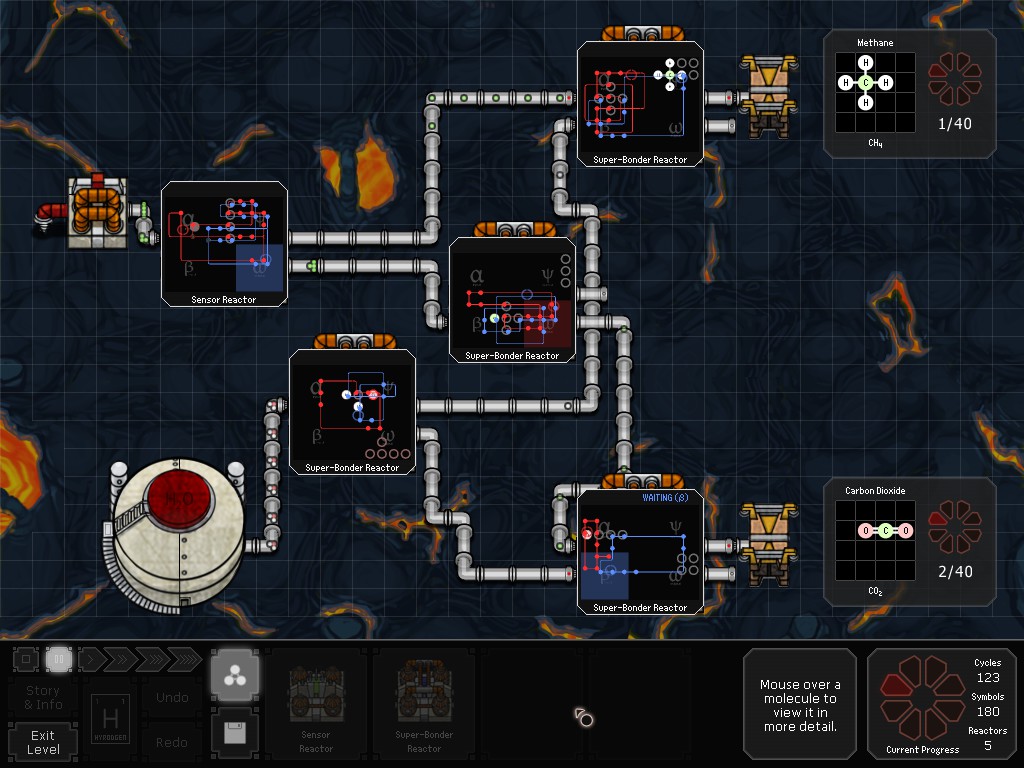
Which brings me to my only real problem with this excellent game - the different types of levels. They are research, production and defence. Research levels are the simplest: a single reactor with two input areas and two output areas.


SpaceChem research level

Production levels allow you to combine reactors to allow for advanced tasks, and may involve three or more inputs and outputs.


SpaceChem production level


Defence levels are like production levels but always include a gimmick which allows you to turn your chemicals into a way to defeat the monster of the week.


SpaceChem defence level

Research levels are tightly focused puzzles which require only one or two bursts of inspiration to figure out and advance. Production levels and defence levels aren't necessarily more difficult than research levels, just bigger and with more opportunities to frustrate. For example, in a production level using 4 reactors you may have spent an hour building the first 3 reactors only to realize while building the 4th reactor that your solution can't possibly work and you'll have to start again from scratch. These kind of levels feel more like a chore after following the fun research levels. There are few optional levels which means you will have to complete these kinds of levels to advance. (I've only seen research levels in the free DLC so far, so maybe the developers have realized where the strength of their game is.)

However, these concerns are minor. If you have any interest in puzzle games, you owe it to yourself to at least try the demo (available on Zachtronichs Industries game purchase page).

Final Score: 8 / 10 - Superb puzzles from easy to really challenging, and new puzzles are continuously being added for free. If it's puzzles you want, you won't be let down (just don't expect anything else - like story, music or pretty graphics).

Notes on my personal rating scale: They are entirely based on my personal feelings about the game - I don't rate a game on its own merits but rather how much I've enjoyed and how much time it's sucking out of my life. Strategy games will do well and shooters poorly because those are my gaming preferences.

0-4 = Poor game that I won't be bothering to play any more
5-7 = Decent game - fun enough that I'll try play it some more if I have the time
8-10 = Good game that I'll be playing a lot more or have already finished and greatly enjoyed

Monday, July 4, 2011

Perfect 10: Puzzle Games and Shooters

In my previous two posts, I looked at games which I would rate at 10/10: RPGs and adventure games, and strategy games and simulations. In this final post of the series, I'll look at puzzle games and shooters.

Portal (Puzzle, 2007)


The basic mechanic of Portal is very straightforward: use your portal gun to open a blue portal and an orange portal that are linked together - anything entering one portal emerges from the other retaining its momentum. But from such a simple mechanic emerges so much variety and head-scratching. The campaign is framed by a minimalist but memorable story, and the campaign levels never becoming overly complex. The campaign is a bit on the short side, but Portal's challenge maps and advanced chambers make up for it.

Portal is currently the only game I own on both PC and Xbox; it really is just such a seminal title in computer gaming. The sequel (reviewed earlier this year) is a worthy successor, but play the original first.

(Available from Steam or consider buying the bundle which includes both Portal and Portal 2)


As for shooters... none so far (and I'm not holding my breath for one).