Showing posts with label Civilization 5. Show all posts

Monday, March 7, 2011

The Blood Bowl Beckons and Other News

The Order of Darkness continues its progress and having won the Chaos Cup now has enough prestige to enter the greatest competition of them all, the Blood Bowl. Sporting a record of 43 wins, 3 losses and 3 draws and carrying a 20 match unbeaten run, I have one hand on the famed trophy already. Only problem is, some skeleton's chopped off the other hand! Star player (nearing on legendary), leading catcher and touchdown scorer, werewolf Simlarg Lowell was killed by a bloodthirsty Khemri team in the preliminary Chaos Cup games. I escaped with a scrappy 1-0 win there with less than half my players on the field in the end.

The Chaos Cup

Civilization 5 has received a new patch described as having made significant balance changes and AI improvements. I can't pretend I'm a Civ 5 strategic master, but I'm hoping for games where there are hard fought, evenly contested wars rather than the AI falling over whenever it doesn't have a huge numerical or technological superiority. I'll give the new patch a fair chance.

Finally, I haven't had a lot of time to spend on Jahger, my Cataclysm Worgen Hunter. But I've managed to do all the new level 80-85 5-man dungeons and acquire enough gear to do heroic dungeons. The new dungeons are all of a very high quality but they almost all have something about them that will annoy some people. My peeve is with Halls of Origination: it's fun with lots of boss fights and even some interesting trash but seems to be too long for the attention span of the average group assembled from the dungeon finder tool (I've only ever managed to finish it once).


Vashj'ir

As an aside, I've upgraded my internet connection and my earlier problems with Cataclysm lag and disconnections have mostly disappeared. It was likely this that caused the new undersea zone, Vashj'ir, to bug out on me as I have now started questing there with no problem. Since I'm max level, questing is mainly done for the gold and faction reputation rewards, but in the case of this zone, I'm just enjoying questing in a quite unique environment.

Saturday, December 4, 2010

Civ 5: Conquering Caesar (Part 3)

With Chivalry researched, I want Knights to continue my conquests. I'm in a bit of a construction phase as I build necessary happiness buildings as well as Barracks in my designated military cities like Cumae and Antium.

I soon have enough money to buy an alliance with Monaco and as units are being built they're shifted across that isthmus to the east. I meet Gandhi of India who inexplicably complains that my units are near his border while I don't even know where his border is?! Never mind; if his border is nearby, then his time will come shortly.

In 820 AD, happiness has reached a high of +18, Rome finishes the Chichen Itza (for 50% longer Golden Ages, should I ever get one), and I adopt the Professional Army social policy (-50% cost for upgrading military). I now start upgrading my old horsemen to Knights at a cheap 75g each.

I see Arabia now has Longswordsmen, a dangerous melee unit. I need to attack soon with overwhelming force. My army is slowly assembling east of Monaco. Harun Al-Rashid is concerned about my army on his western border. I bluff, claiming I'm peaceful, as I don't really care about my reputation anymore.

In 1000 AD, Genghis Khan declares war on Washington, while I declare war on Harun al-Rashid. The city states of Rio de Janeiro and Tyre are on Harun's side though I have little concern for them.


2 Knights and a Legion are enough to take the first city, Kufah, to be razed. As my forces heal up and reinforcements arrive, Arabian forces rush to defend Mecca. There are more defenders than I expected and I have to employ some tactical withdrawals, keeping out of Mecca's bombardment range to ensure I have decent odds against Harun's units. With the Discipline social policy bonus (+15% while adjacent to another of your units), Great General bonus (+25% within 2 tiles) and flanking bonus when I can, I whittle away at Harun's army. I have a few cases where a Knight barely survives, but by the time Harun's forces are exhausted, I haven't lost a single unit.

Meanwhile Washington loses his capital to Genghis Khan, and my happiness triggers a Golden Age (for 15 turns). It's time to start capturing cities and driving down that happiness again.

After 10 turns of battle out in the open, my army advances on Mecca itself. It consists of 6 Knights, 3 Legions and a Great General, with even more reinforcements on their way. Just 3 Knights and a Legion are needed to capture it.

The army then splits up to take the remaining Arabian cities. To the south, Damascus has cotton and spices for me - it's captured by 2 Knights. To the north, Medina has Stonehenge - and it's also captured by 2 Knights. Then, to the east, the cities of Najran and Basra are also quickly taken with 3 units each. Finally my army descends on Harun's final city of Baghdad which is captured in 1170 AD after 17 turns of war.


During the war, I've earned a Great Scientist and wasted it on Steel, thinking I could get Military Science with him. No matter; Knights seem sufficiently powerful for now. Also, Rome has built the Forbidden Palace (-50% unhappiness from number of cities), but after the Arabian conquest, I'm still left at negative happiness.

I've also spent money to get an alliance with Sidon south of Arabian lands. Although I've spied Indian lands to the east, I want to check out if there are any civilizations past Sidon.

In 1210 AD, with an army that includes 11 Knights massing on India's doorstep, I declare war on Gandhi.


Gandhi has a few units defending Delhi, his capital. As my Knights surround the city, his co-ordinated fire takes down one of my Knights. But his units easily fall and Delhi is immediately captured.

My happiness has dropped to -12. I plan to get all future Golden Ages through wonders and great people anyway, but at -10 happiness you take combat penalties. So I spend money rush buying Theatres and otherwise building more Theatres where I can, as well as the Notre Dame in London (for +5 happiness).

Some of the amry heads north to Vijayanagara and capture it two turns later, while the rest advance on Mumbai. During the attack on Mumbai, a Great General is born, to be used for a Golden Age when needed. I capture Mumba in 1270 AD, eliminating Gandhi after just 6 turns of war.


After a bit of resting up and scouting, I find Washington to the south of Indian lands, beyond the city states of Helsinki and Tyre. Not really what I need as Washington's already lost his capital; but an easy conquest I can't refuse and it might lead to the last civ, the Mongols. I spend money for an alliance with Helsinki to make moving my army there a bit easier (I still don't have Optics to enable my units to travel on water).

As my army begins to mass near Atlanta, I see Genghis Khan is still at war with Washington, and is busy attacking Atlanta. Even as Washington stoically defends against Genghis's assault he asks for assurance about the units on his border. I let him have the bad news as a I declare war on him in 1340 AD. I proceed to steal Atlanta from under Genghis Khan's nose, which eliminates Washington.

I can now see Genghis's American conquests to the south of Atlanta. I've also spotted a Mongolian city across a channel south of Sidon. While my eastern army trickles down to Atlanta and Boston, new units are diverted to Sidon. I finally research Optics so those units can cross the channel and put pressure on the Mongolian west. I've also researched Military Tradition and start upgrading my experienced Knights at 115g each.


My Golden Age from happiness ends, and I start a new 22 turn Golden Age with the Taj Mahal built in Moscow. With 6 Cavalry at the front and more incoming, I declare war on Genghis in 1370 AD.

He appears to have quite a few units, but they're mostly backward Archers, Horsemen and his unique unit, the Keshik. I quickly learn that Genghis has built the Great Wall (how ironic!) which limits the great manoeuverability of my Cavalry (movement inside his borders is slowed). So while I'm able to pick off his units with ease, my own units are left very vulnerable. Fortunately, they weather the counter-attack with just a few bruises.

After 3 turns of clearing out his defenders, my Cavalry stike at Boston and raze it. The army rides on south to Washington. Again my most forward Cavalry, despite being really vulnerable, survive the counter-attack from Genghis's forces. After a few more turns, I don't see any more Mongolian units and I safely capture Washington.

I capture, Turfan, the city across the channel from Sidon, but I have too few forces there to really exert any pressure. My eastern army splits up, hunting for the Mongolian capital. They capture New York and Tabriz in short order.

I see Genghis rallying the last of his forces at Beshbalik - he finally has a Musketman amongst his defenders. But with the size and power of my army, it just tramples them underfoot to capture Beshbalik.

They then spot Genghis's capital, Karakorum, and even my wounded Cavalry ride on to assault it. The most forward units, a Trebuchet and 2 Cavalry are enough to capture it in 1480 AD (turn 208), giving me a Domination victory; my first win on Emperor level and also, by far, my fastest victory of any kind on a standard-sized map.


This is the first time I've gone for almost continual warfare from the moment I got my first horses, and it's a strategy that the AI seems to be weak against as they just don't have enough defenders and are generally weak at waging war. Once you have a few cities conquered, your strength just snowballs, as your growing Empire gives you the finances and research to continue to wage an increasingly lopsided war.

Tuesday, November 30, 2010

Civ 5: Conquering Caesar (Part 2)

The ongoing plan now is to continue my conquering ways, growing my empire as much as possible while trying to manage my happiness which, of course, goes down with every conquered city. The plan is to only keep cities that have resources or happiness infrastructure and back-fill the gaps as happiness allows.

So as soon as my mounted army arrives on the English border, I declare war on Elizabeth in 675 BC.


Three Horsemen are enough to immediately capture Hastings. Then as my army moves on to Nottingham, Catherine also declares war on Elizabeth. She's also attacking Nottingham, and helps me out by eventually bringing it down into the red allowing me to capture it the following turn.

In the process I see Catherine's forces are fairly insignificant and the Russian cities must be close by, so if I can win this war with Elizabeth quickly, I'll be targeting Catherine next.

There's no resistance as my forces take York except for Elizabeth begging for peace. As the Horsemen advance on London, I finally hook up my iron in Neapolis and start on building Roman Legions.

I capture Elizabeth's final city, London, in 425 BC (10 turns of war); and as I prepare for the attack against Catherine, I begin researching towards Chivalry so that I can eventually upgrade my elite Horsemen.

I've also spent gold to form an alliance with Copenhagen for its fur luxury and iron resource; and have started constructing a lot of buildings in my cities, particularly the happiness buildings, Circuses and Colosseums.

I've found the Russian civilization is to the south-east of the old English civilization. With my happiness finally back to positive levels, in 300 BC I declare war on Catherine and my Horsemen ride in to immediately capture the Russian city of Rostov.


My horsemen then try to advance on to Novgorod just east of Rostov but across a mountain range. Only a single difficult pass traverses the range, and some careful manoeuvering is required to limit casualties to a single Horsemen. But the hit and run capabilities of the Horsemen eventually whittle away all of Catherine's Spearmen, and so Novgorod falls.

Both the Genoa and Copenhagen alliances run out at the same time and I only have the gold to renew the alliance with Copenhagen. Fortunately though, the size of my empire (which is all connected by roads into my trade network) means I'm bringing in a sizable sum each turn and it's not long before I can rebuy my alliance with Genoa.

I've obtained just 1 social policy in the Honor tree, and as the costs for social policies escalate with each city captured, I look at an alternative and so start Rome building the Oracle for its free social policy.

Meanwhile the Horsemen capture the northernmost Russian city of Yekaterinburg. I lose a Horseman while scouting out the rest of the Russian civilization, but the rest of the Horsemen take Moscow, the Russian capital, with no more resistance.

The 2 Legions I've built with my initial iron finally reach the front, giving my army a boost it didn't really need. The army consists of 3 Horsemen, 2 Legions and a Chariot Archer, and they advance on St Petersburg, clearing out a solitary defending Spearman.

It's not all good as even as I capture and raze St Petersburg, the Oracle is built in a faraway land, beating me to it by 3 turns. I'm also down to -12 happiness and desperately looking around for extra sources of happiness, hooking up and trading for luxuries as soon as I'm able.

Yaroslavl' is finally captured in 175 AD, eliminating Catherine after a 19 turn war.


Peace again, and since I don't even know where Harun al-Rashid or the recently met Washington of America and Genghis Khan of the Mongols are located, I use up one of the Great Generals that was produced during the war to trigger an 8 turn Golden Age. It's primary benefit is to push along the production of those happiness buildings and develop my new under-developed conquests.

With all the infrastructure already completed in Rome, I start building the Chichen Itza there (+50% Golden Age length), though I'm uncertain how many Golden Ages I can reasonably expect considering my happiness problems. Still, it's the best of the wonders still available.

Just as my Golden Age ends, I get the next social policy in the Honor tree, Military Caste, which reduces unhappiness in garrisoned cities. To help the happiness situation, my army disperses amongst the conquered cities.

And then an exploring Horseman finds the Arabian city of Damascus. Spotting that it has a low city strength, and with Chivalry having just been researched, I feel confident that I can quickly conquer Arabia. However I need to reassemble and rebuild my army, upgrade Horsemen to Knights and move them past the isthmus occupied by Monaco who is already unhappy with me.


But another vulnerable civilization; how can I resist? A Roman isn't cut out for the life of a farmer - there will be war again soon.

Continued in Part 3

Civ 5: Conquering Caesar (Part 1)

My first attempt on Emperor level had ended pretty quickly - a half-hearted attack with Swordsmen against Musketmen provoked the ire of my neighbours who did me in pretty quick. A few more games at King level has restored my confidence, and hopefully refined my strategy. My experience has continued to show that the AI is weak in times of warfare which is all well and good while you're not technologically behind. So the plan is to push for early war, possibly in the classical era with Horsemen or Swordsmen or an early unique unit if my civ has one.


I draw Rome as my random civilization which dovetails well with my plan. Their Legion unit is a small upgrade over the early Swordsman. After moving to settle Rome a bit away from the unproductive mountains, I have quite a few nearby resources. In particular I want to get the early techs to improve the sheep and deer, Animal Husbandry and Trapping. As a bonus, I can check out if there are any horses nearby before heading down the tech tree to Iron Working.

I get lucky with my scouting Warrior exploring ruins the turn after settling giving me an early boost to my population. That scouting Warrior also finds my neighbour, Askia of Songhai is worryingly close. Fortunately there are horses between Rome and Goa, and my plan is to rush him with Horsemen quickly.

As I start researching towards Horseback Riding, I implement the Liberty social policy for quicker Settlers. I want to get 2 or 3 quick cities to produce a few Horsemen quickly when the tech comes in. By 2280 BC, I've settled two more cities, Antium and Cumae, by sources of horses.


Askia settles Tombouctu right between us - a prime target when I've built my army. He's been threatening me the whole time, laughing at my pitiful army and otherwise being annoying. By 1120 BC, I have an alliance with the city state of Genoa, started on the Honor social policy tree and have trained 4 Horsemen, 1 Chariot Archer and a few Warriors - enough for me to feel confident of my chances, and so I declare war on Askia.


Meanwhile I've discovered a few sources of iron, with the safest on the coast to the east, so I start up a Settler for there while the war begins.

A quick strike by my Horsemen capture Tombouctu. Unfortunately, Askia has more units in the area and the city is recaptured in his turn, costing me a Horseman. But the rest of my units close in and the city trades hands again. The city is to be razed; all the enemy units have been killed; the army rides on to Gao.

In 925 BC, just 6 turns after starting the war, I capture Gao, eliminating Askia. That war went extremely well; though it was helped by the fact that Askia spent a lot of production on the Great Library, now a fine addition to the Roman empire.


My happiness has dropped to critcially low levels: -10 which means I can't even settle my iron city. I research Calendar so I can improve the luxury resource tiles. When that's done, I settle Neapolis on the coast by the iron.

I've met Elizabeth, Catherine and Genghis Khan, and I know English lands are to the south, so my horsemen head down there to see if I can continue my conquering ways.


Continued in Part 2

Tuesday, November 9, 2010

Weekend Gaming

With no rugby to distract me (except for a minor skirmish between South Africa and Ireland), this weekend was full of gaming...

One Weekend's Gaming

First up was Civ 5. During the week I'd been hopelessly trounced playing on Emperor level, so I set out to get some revenge against King level. My random leader was Alexander who excels at early warfare and city state alliances. I never got the early warfare going and I've been keen to win a peaceful game at this level, so I targeted a cultural victory with only 3 cities. Getting the culture required (5 completed social policy trees = 30 social policies) is actually easier with fewer cities - it's just surviving with the resulting financial, scientific and military deficit that's the problem.

Fortunately one of my neighbours was Gandhi who was just as peace-loving as me, but Elizabeth's growing aggressiveness became a problem as she gobbled up all the other civs and city states on the continent. Despite all the deals I could make to appease her, eventually she came for me. I desperately held her off with my inferior military while I picked up the last social policy I needed and started building the Utopia Project. A few well-trained mech infantry and artillery couldn't hold off Elizabeth's swarm of tanks, cavalry and infantry forever and I eventually lost my western-most city, Sparta. With the enemy beating at my gates, I finally finished the Utopia Project in Athens to snatch victory from the jaws of defeat.

Civ 5 - A Desperate Defence

Next I finished the first act of Titan Quest with my battlemage, defeating the Greek Telkine. Despite friends trying to convince me otherwise, I just don't find the gameplay interesting enough to continue on to Act 2. Maybe if those friends were to join me for multiplayer, I'd play on - I can forgive a game for a lot of faults if it provides a fun multiplayer experience.

The action RPG nature of Titan Quest made me realize that what I really wanted was to play a proper tactical, story-based RPG like Dragon Age: Origins. Having finished it twice now, I decided to get the expansion, Awakening, and continue playing with my somewhat evil dwarven rogue. I haven't got very far, having just acquired the first two party members, but I'm already appreciating the less actiony combat compared to Titan Quest.

Before playing any further, I discovered a couple of free games on GOG.com (Good Old Games) including classic adventure game, Beneath a Steel Sky. I've never played it before, but heard good things about it and the blurb on GOG makes it sound similar to the excellent RPG setting of Paranoia.

Of course it's a point-and-click adventure game which are enjoyable while you're successfully solving the puzzles, discovering new locations and characters, but get frustrating as hell when you're stuck. When I've got three other games clamouring for my attention, I'm not going to sit and stare at the screen blankly while trying to guess the author's bizarre way in which putty is to be used. Fortunately while looking for a walkthrough, I discovered a website, Universal Hint System, which provides carefully formulated and staged hints on how to progress for all sorts of games (including Beneath a Steel Sky). I've used the hints 3 times now and it's made playing the game really enjoyable. The story's a bit strange and the humour is hit or miss, but overall it's good enough that I'll finish it.

Beneath a Steel Sky - State of the Art in '94

All this PC gaming was interrupted by a visit from a friend who's been exiled to Cape Town (hopefully temporarily). With her she brought the acclaimed Battlestar Galactica boardgame which occupied much of our Saturday. Despite still learning the rules and it taking an age to finish, we all really enjoyed it. The game is somewhat co-operative in that the players are humans trying to work together to jump the Galactica to Cobol - but the key element that makes the game work is that one (or more depending on numbers) of the players is secretly a human-looking Cylon, a skinjob, working to sabotage their efforts.

I played as Laura Roslin, President of the Twelve Colonies who was usurped in a military coup by Saul Tigh. Holding both the Admiral and President titles, I was convinced he was the Cylon, only for Lee "Apollo" Adama to surprise us by revealing his true Cylon nature. The timing of the reveal was bad as we were critically low on all resources and we were lucky to survive the super crisis that followed. We made it to Cobol with all our resources down to just 1 or 2 units left.

I'm looking forward to playing a few more games so that I can give Battlestar Galactica a proper review. In particular, I want to experience playing as a Cylon as I'm sure the game plays very differently. Overall Battlestar Galactica was a great peak in an enjoyable weekend of gaming.

Tuesday, October 19, 2010

Civ 5: Great Thebes (Part 2)

I've just eliminated Darius of Persia and was attacking Hiawatha of the Iroquois, when Elizabeth of England betrayed me and attacked my undefended Persian conquests. Within two turns, Elizabeth captures Osininka.


I split my army to try counter both my enemies. A holding force is left by Memphis to pick off what Iroquois forces I can and I direct the rest to the east to try reclaim Osininka. After killing a few of his units, I sign a peace treaty with Hiawatha, even getting some gold and a luxury out of him, but more importantly allowing me to focus my efforts on Elizabeth. The remnants of my southern army capture Akwesasme, a former Iroquois city held by Elizabeth, and then they reunite with the eastern army.

With Elizabeth marching on Pasargadae, I focus on recapturing Osininka. The speed and power of my Knights allows me to pick off a lot of her units and capture Osininka. With her army in disarray, I focus on picking off what few units she has left as I march on to the English-held city of Susa.

Meanwhile my Caravel has met up with Augustus Caesar of Rome and Catherine of Russia. Both want me to join against each other - I side with Caesar and agree to go to war with Catherine in 10 turns time. I'm across the sea from both of them and so don't expect to ever be under attack from Catherine as I haven't seen her with Caravels yet. I've been progressing quite nicely along the tech tree, and I reach Gunpowder. However, I'm quite happy with my mobile Knight army and while I still have so many horse resources left, I'll continue to build them rather than Musketmen. Money's been rolling in and I have enough to buy another alliance, this time with Lhasa on the north-east of the content. Thebes builds the Forbidden Palace, helping me out with happiness in my continuously growing empire.

The Knights of my eastern army capture Susa, but her Longbowmen kill one of the Knights protecting Susa before it's razed. I clear out these remaining enemy forces and then capture her northern cities of Canterbury and Conventry with no resistance. With my army heading south for Elizabeth's core cities, my time expires and, along with Caesar, I declare war on Catherine. The last few English cities fall quickly with only a few token Spearmen remaining to defend them - York falls, followed by London, then Hastings, and finally, in 1555 AD, Elizabeth's final city of Nottingham.


My Caravel meets up with Montezuma of the Aztecs and Oda Nobunga of the Japanese on yet another continent, this one to the south-west. I've met all the civs now. I also meet the city state of Belgrade which is under attack by Montezuma, and the city states of Copenhagen and Hanoi also on that continent. I implement the final social policy of the Patronage tree meaning I'm getting substantial bonuses from all my city state allies.

My army has been redeploying to Memphis, ready to resume the war with Hiawatha. In 1580 AD, I declare war against Hiawatha and advance into Iroquois lands. The Iroquois archers fall quickly and Hiawatha's counter-attacking units are so outdated that they have little effect against my Knights. His northern-most cities of Grand River and Onondago, his capital, are quickly captured. The Knights continue south, razing Brantford, Montreal, Akwesasme (named for the city razed in my previous war against Elizabeth) and then the new capital, Buffalo Creek, is captured. This is the final Iroquois city and Hiawatha is defeated in 1615 AD.


The whole continent is mine - even all the city states, except for Geneva, are my allies. Montezuma comes asking for me to join a war against Japan. Looks like my Knight army has some more conquests to make - I ask for 10 turns so I can transport them across to the Aztec and Japanese continent.

Continued in Part 3

Wednesday, October 13, 2010

Civ 5: Great Thebes (Part 1)

I've made some progress in my next attempt to defeat King level in Civ 5. I'll be blogging the abridged version of the game here and provide a more detailed recap on the CivFanatics forums when I've finished the game. Update: detailed recap now posted.

My random leader this time is Ramasses of the Egyptians. The unique ability is a bonus to wonder production, so my initial strategy is to focus on wonders.


My capital, Thebes, is nicely situated with marble, cotton and cattle resources, and a good mix of river grassland for farming and hills for mining. Before even expanding, Thebes builds the Pyramids and Stonehenge.

Expanding to a second city is mistimed as another civilization beats me to the Great Library. I get some financial compensation for my hard work though, and I use the money for an alliance with Stockholm. My Settler heads south to gold and plentiful horses near Stockholm and founds Memphis in 1080 BC.

When I clear out some barbarians for Florence, I gain enough influence to become friends with them. I decide now that I want to try and pursue a somewhat diplomatic game, or at least pursue a strategy of making allies of the city states. To do so is best served by pursuing the Patronage social policy tree.

Researching Theology pushes me into the Medieval Era and I complete the Oracle, giving me 2 social policies in quick succession as I start down the Patronage tree.

A Great Engineer rushes the Hagia Sophia (for even more great people) and, with Thebes and Memphis looking in good shape, I send out another Settler who founds Heliopolis to my north-east in 75 AD.


The other leaders on my continent are Hiawatha of the Iroquois to my south, Darius of Persia to my east, and Elizabeth of England to my south-east. The first great war pits Darius and Elizabeth against Hiawatha. With Darius conquering the Iroquois settlement of Osininka, that seems to satisfy him and he soon signs a peace treaty with Hiawatha. That does however leave a lot of Persian forces wandering around my lands, making me a bit uncomfortable as I don't have much of a military at this stage.

I make a plan to build up some forces for a war I'm sure will inevitably come. I have a lot of horse resources, so I start researching towards Chivalry for Knights. In the meantime I build Pikemen, War Chariots and, eventually, Horsemen.

Then Darius attacks Stockholm, my city state ally. I'm still 1 tech away from realizing my military build-up and so I'm not ready to take on Darius just yet. I stay out of it and hope Stockholm can hold out against Persia's Immortals.

When Elizabeth and Hiawatha sign a peace treaty, Hiawatha asks me to join in a war against Darius. I ask for 10 turns to prepare as I've just entered a Golden Age and still don't have Chivalry. When the Golden Age concludes, I upgrade my Horsemen to Knights and begin the war against Darius. Both Hiawatha and Elizabeth join this crusade to get rid of Darius. Darius's army is soon destroyed and his cities fall in quick succession to my powerful Knights.

With the war over, I concentrate on making more allies. I spend money for Helsinki, Brussels and Tyre to join me.

Meanwhile, my Knights are growing restless and with a war between Elizabeth and Hiawatha having broken out, I sense an opportunity for some more gains. When I see Elizabeth capturing the Iroquois city of Akwesasme, I know it's time to join the war. With my forces mobilized on my southern border at Memphis, I declare war on Hiawatha and strike out at his nearest cities.

This is immediately followed by Elizabeth declaring war on me! Her forces assault the former Persian city of Osininka with my army nowhere near.


I'm now in a war against both remaining civilizations on my continent, with just one intrepid ship set sail to try meet some friends across the ocean.

Continued in Part 2

Friday, October 8, 2010

Civ 5: The Golden King (Part 2)

I've just entered my second Golden Age, and the techs and infrastructure start rolling in. I discover Acoustics, Engineering, Machinery, Physics and Steel. I build Satrap's Courts, the upgraded Persian version of the Bank with bonus happiness, and the Notre Dame for even more happiness. I also implement the Mandate of Heaven policy in the Pietry tree for extra extra happiness. Towards the end of the Golden Age, I get an update on the tech leader - it's comfortably me.


Also during the Golden Age, Caesar joins Napoleon in the war against Alexander. They ask me to join them, but I decline due to my rather thin military. It's not long before Caesar pulls out of the war with a peace agreement with Alexander. Alexander is making great progress in his conquest of the French. He also captures Ragusa, the city state on my southern border.

An unknown civilization on the other continent loses his founding capital. This is significant as to win a Domination victory, it is sufficient for each other civilization to have lost their founding capital.

At this time I run into a slightly annoying bug. One of my pearl luxuries has disappeared. It still appears on my map and can be worked, but I've only got 2 of them to trade. Reloading or re-Work Boating doesn't help, so I'm permanently one luxury short.

I discover Printing Press which allows me to build Theatres for more happiness and the Taj Mahal for a bonus Golden Age. I implement the Reformation social policy in the Piety Tree, triggering an immediate 6 turn Golden Age (boosted to 9 turns for me), and start building the Taj Mahal.

I start researching Astronomy so I can cross the ocean and meet the other 3 civs, and then I learn the Aztec civilization is conquered, leaving just 2 civs to meet. It looks like there's a very strong civ on the other side of the world and I want to meet them soon.

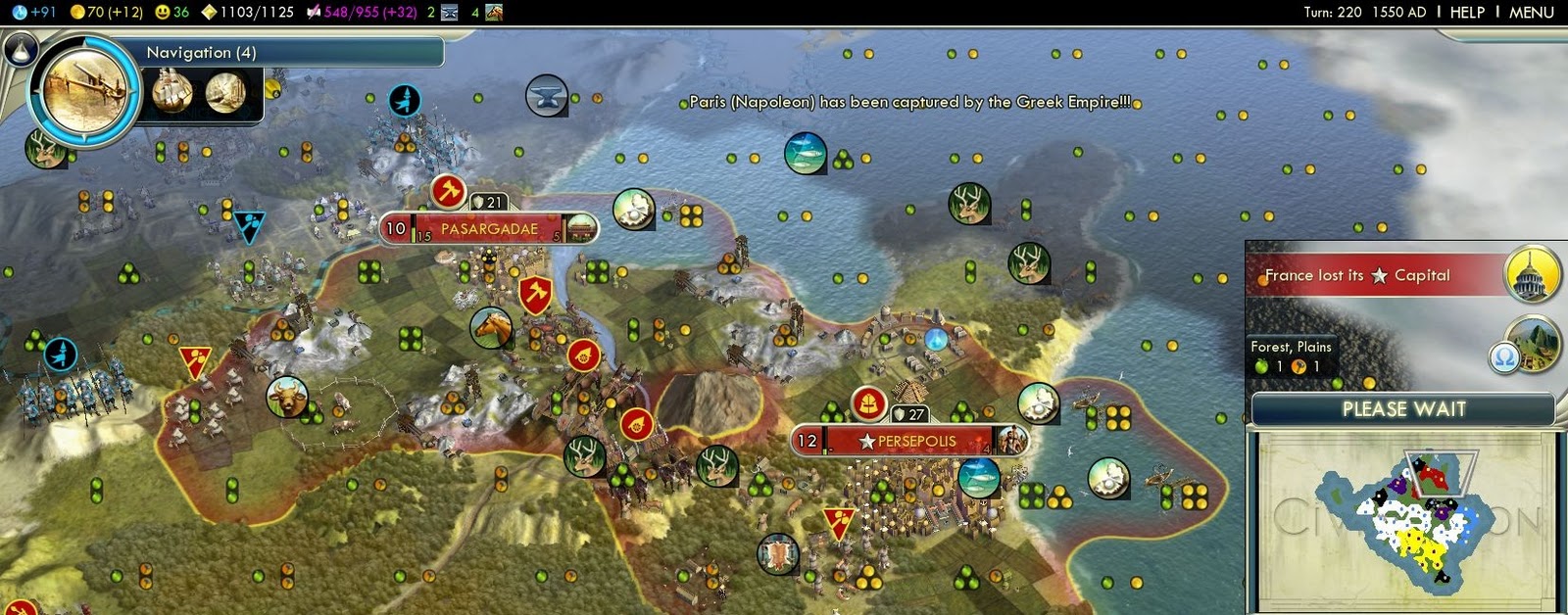
As my Golden Age ends, the French start mounting a bit of a comeback as they reclaim their city of Tours. Napoleon continues his recovery by capturing Genoa, a city state ally of Alexander's. My capital, Persepolis completes Oxford University (national wonder for universities) giving me a free tech.

It's looking good, and I'm feeling ready to expand again as I'm about to enter another Golden Age from accumulated happiness, when suddenly Paris falls.


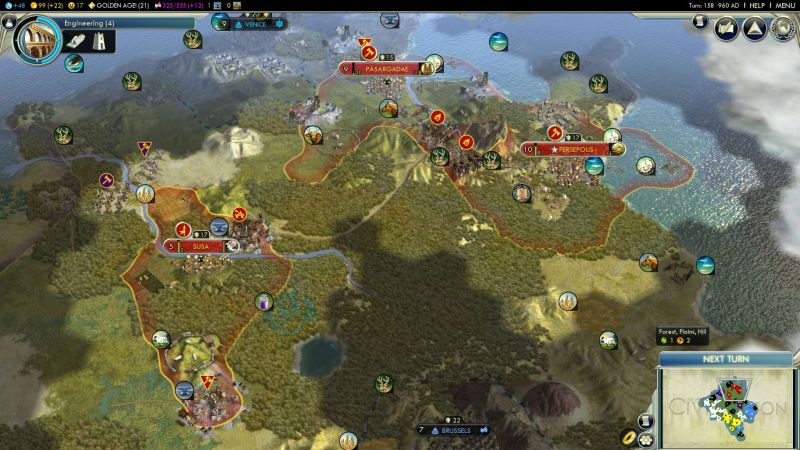
My fourth Golden Age begins in 1555 AD (to last 22 turns). Surveying the map now, it looks like Napoleon is on the verge of being eliminated, but as Pasargadae completes the Forbidden Palace which reduces unhappiness from number of cities, I settle my fourth city, Ecbatana in the vacant south-east area near my cities.


My Caravel completes and begins its trans-oceanic explorations, meeting up with the two civs on the other continent: Ramkhamaeng of Siam and Harun al-Rashid of Arabia as well as a number of city-states all at war with Ramkhamaeng.

My third city, Susa, completes the Taj Mahal, which would normally give me a free Golden Age, but because I'm already in a Golden Age it merely extends it by the length of the Golden Age. I'm expecting an extra 22 turns, but instead I get an extra 49 turns! Yet another bug I assume; even though it's in my favour, it's still annoying.

And then the last French city falls. I really hope Alexander's eyes look towards his former enemies in Ramasses and Caesar now as my defences are still pretty sparse. I sign a number of deals with him - selling my luxuries for gold each turn, open borders and a research agreement. The nearby city state of Vienna falls to Alexander and his forces look menacing on my southern border. I can not afford a war right now.


In 1680 AD, Alexander declares war on me :( His city state allies join him: Edinburgh, Singapore, Brussels and, most worringly for me, Venice on my north-west border. A swarm of Riflemen enter my territory and I now have to desperately defend.

My entire army is a Warrior, two Chariot Archers, a Pikeman, a Crossbowman, a Longswordman, a Catapult and a Rifleman. That means I have exactly only one unit that is competitive with this invading army. The rest are hopelessly outdated, and do almost nothing in combat. I start desperately building walls in my southern cities and training new units in the north. I take out some loans and rush-buy another Rifleman.


Although I take out a few Rifleman, I lose almost all my units in the process. I'm down to just a Warrior and my new Rifleman when my southern cities of Susa and Ecbatana fall. That Warrior soon falls - my last Rifleman does what he can, earning a promotion and healing back up to full health, but it's not enough as he falls too. Pasargadae falls in 1725 AD.

A newly trained Cavalry in Persepolis is my last line of defence. I am desperately hoping Alexander will negotiate a peace settlement, but he's ruthless. In 1735 AD, his army surrounding Persopolis brings down my capital, leaving the Persian empire as a sparkling little footnote in the pages of history.


So I lost. Beside the annoying bugs, I'm actually glad to see the AI able to successfully pull off full-scale civilization invasions. I've definitely got a new respect for it, and hopefully have learned my lesson to build more military units and keep them up to date. I'm certainly not afraid to tackle King level again.

Wednesday, October 6, 2010

Civ 5: The Golden King (Part 1)

So far I've won games of Civilization V up to Prince level. I now start pushing on to harder difficulties where the AI gets bonuses against you. On King level, I pick random for my leader, and I get ... Darius of Persia. All the civs get a different special ability, unit and building. Darius's ability is quite interesting: +50% Golden Age length. In a Golden Age your production and commerce are greatly improved. I already start formulating a plan to trigger Golden Ages as often as possible, possibly with an eye towards winning the space race. Golden Ages are triggered by accumulating large amounts of happiness over several turns. A small empire with several luxuries, happiness improving buildings and appropriate social policies is my strategy for earning this happiness.

Settling Persepolis

In 4000 BC, I settle Persepolis. There are some nice resources nearby and my first choice is between researching for the land-based resources or the sea-based resources first. Decide to go for Animal Husbandry (towards Trapping) since each work boat is consumed when used, whilst an early worker can go on to other improvements.

I build a Scout and, along with my initial Warrior, they explore my starting landmass. With Civ 5, the world is quite well occupied from the start with 16 city states joining the 8 major civilizations. I meet up with a few nearby city states (Venice, a maritime city state, gives a food bonus to its ally, and Brussels, a cultured city state, gives out culture to its ally). I also meet my nearest neighbour, Augustus Caesar of Rome.

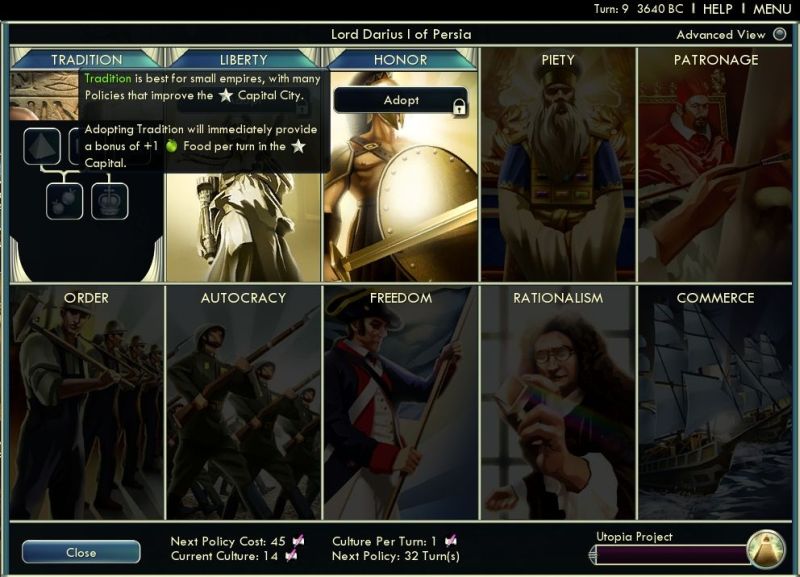
I get an early boost to my culture as a random reward from my Warrior exploring some ruins. Culture is spent on social policies - 10 separate "culture trees" that grant various bonuses, and I immediately have enough to implement my first policy. Since I'm still in the Ancient Age, I'm restricted to only 3 options - Tradition (good for your capital), Liberty (good for an expanding empire) and Honor (good for military). Since I'm going to stick to a smaller empire, I pick Tradition to get a small bonus to growth in my capital.

Social Policy: Tradition

A barbarian encampment on a hill has spawned near Persepolis, so I bring back my Warrior and rush-buy another Warrior to deal with it. It's started spawning Brutes to attack me, and although cities are quite capable of defending themselves, I don't want to lose my Worker to the barbarians at this early stage. When the barbarians are swiftly dealt with, I have a Worker and the Trapping tech to improve the deer and fur tiles.

My scout continues to explore, meeting Napoleon of France, Ramesses II of Egypt and Alexander of Greece, along with a number of city states. I also get enough culture for another social policy - I can either pick another policy or make choices in the Tradition tree; I take Aristocracy in the Tradition tree, giving my capital a bonus to wonder production so I can shoot for some early wonders.

I research Sailing and produce a couple of Work Boats to work the fish and pearls. With the pearls and furs, I'm getting a nice boost to my happiness and a push towards a Golden Age.

I also produce my first Settler and, in 2400 BC, establish the city of Pasargadae to the north-west. The nice cattle tile is just outside of my initial borders, but I can spend some gold to expand my borders there. Happiness has immediately dropped from building a new city. Since number of cities and population both contribute to unhappiness, I'm going to be careful about how much I expand.

Pasargadae settled

Writing is discovered and so I start Persepolis building it's first wonder, the Great Library which will give my a free tech if I complete it. I get a pop-up with all the civs listed in order of their technological progress. I'm last. :( I start signing Pacts of Cooperation with my neighbours, and when I get the money, Research Agreements. These are the primary way of turning cash into tech, approximately 250g each will get you a random tech (that you can research) in 25 turns time. Since you can't trade techs anymore, this is the way for co-operative civs to catch up in the tech race, and I plan to do it as much as my funds allow.

Great Library

Persepolis completes the Great Library, and I enter the Medieval Age in 1640 BC with the free tech of Civil Service. It allows me to build a very useful Wonder for my strategy: Chichen Itza, which increases my Golden Age length by a further 50%. Unfortunately it requires a lot of production to finish, so I'll wait for my first Golden Age before I begin building it. Meanwhile I start building libraries to improve my research. I also start back-filling the tech tree since the Research Agreement techs are random, and I'd rather randomly be given an expensive tech than one that's quick for me to research.

I clear out a barbarian encampment and rescue a Worker for my neighbouring city state of Venice, for which they reward me with an alliance - bonus food for the next 20 turns (at which time my influence with them will have decayed back down to friendship).

With my next social policy, I choose Legalism in the Tradition tree for less unhappiness in my capital, effectively resulting in more happiness and brining me closer to a Golden Age.

In 1280 BC, I reach a cumulative 500 happiness and my first Golden Age triggers (lasting 15 turns). I start Persepolis on building Chichen Itza. It completes not long after the Golden Age ends and I start Pasargadae on the Oracle for the free social policy it provides.

Another pop-up with the technological progress of all the civs, and my research dedication and Golden Age has paid off as I'm at the top of the list. I've also just discovered Iron Working revealing plentiful iron to my south-west and a good spot for my third city. In 250 BC, I settle Susa in range of two iron, a dye, a wheat and a sheep.

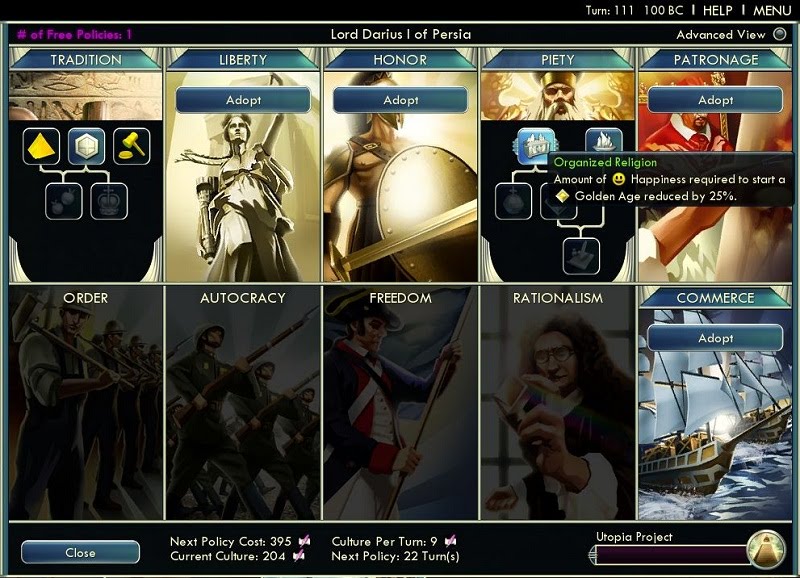
Meanwhile, I've started working on the Piety social policy tree which is the tree for improving happiness. When the Oracle completes in Pasargadae, I choose Organized Religion as my free social policy.

Social Policy: Organized Religion

I'm focusing on research and infrastructure when Alexander calls me up to insult me. I realize my army is looking a bit thin and resolve to beef it up somewhat. With my horse resource, I can train 2 horse units, so I train some Horse Archers, an early ranged unit with nice mobility.

Although the civs have had many minor skirmishes with the city states (with Almaty conquered by Egypt), the first real war breaks out in 480 AD with Napoleon attacking Ramasses and Alexander coming to Ramasses's aid. I stay clear of the war, teching to Banking and entering the Renaissance Era first in 900 AD.

I've also built two national wonders in Persepolis - these are wonders that require all of your cities to have a specific building (another bonus for smaller empires). Persepolis has the National College (requires libraries, boosts research) and the National Epic (requires monuments, boosts great person production). With the boost from these, a great scientist is born in Persepolis. I can use him for a Golden Age, a free tech, or a research improvement on one of my tiles, which I think is probably the best long-term investment (since the great person Golden Ages have diminishing returns).

The next turn, in 940 AD, I enter my second Golden Age (this time lasting 22 turns!) I'm happy that my strategy seems to be working out so far and I resolve to push on building infrastructure during the Golden Age.

2nd Golden Age

Next session, I'll see how long my peaceful ways can last and how long I can spend in Golden Ages.

Continued in Part 2

Monday, October 4, 2010

Review: Civilization V (PC)

For me, the Civilization series really epitomizes some of the traits I appreciate the most in a computer game: strategy, emergent story, great replayability. My first encounter with Civ 1 at a friend's house changed the way I view games with my collection of arcade-like titles turning into a pale shadow of true gaming. Each title in the series has gone on to become one of my most played games. If you want an unbiased review, go hunting elsewhere, but for all the civ addicts and those who share my tastes and want to know whether Firaxis's latest offering is indeed the "most well-designed Civ ever developed", read on...

The Civilization games are empire building sims that play from the founding of your civilization's first settlement to, potentially, futuristic wars and space colonization in the year 2050. While the epic scope of the series has been retained, much of the appeal of these games (particularly Civ 3 and Civ 4) has been in all the different facets of your civilization that you have to manage, yet in Civ 5 things have been greatly simplified. The original Civilization was originally based on the Civilization boardgame, and now with this fifth incarnation, it feels more like a boardgame than ever. This is mainly because of the 1 military unit and 1 non-military unity per tile rule.


Civ 1

There are plenty of other simplifications with staple elements simplified or removed: a simpler tech tree, no tax slider (to control research or luxury spending) and no tech trading. New additions in Civ 4 and its expansions have been cut: religion, espionage and corporations. To compensate for all the subtractions, there are some new complications such as city states, added as minor civs that don't compete to win the game but whose alliances provide various useful bonuses.

The end result though is that Civ 5 plays less like an empire sim and more like a strategy board game. Fortunately I like boardgames, so this isn't necessarily bad. In particular, combat is more fun with greater tactics involved than simply building up a "stack of doom". And although it might feel simpler, there are probably just as many viable strategic options as before.

This brings us to the one clear weakness of the game: the AI. On the fair playing field level (prince), they're just not very competitive, particularly in combat. Smart use of terrain, ranged bombardment and tactical withdrawals will win against an AI opponent's superior forces. It's nice that good play can make such a difference, but disappointing that in only my 3rd game I was able to win the major war of the game with only a handful of casualties.


Civ 5 - my Aztecs conquering the Russians

I've also experienced a number of annoying glitches. For example, I can't scroll left with the mouse on my dual screen set-up and the graphics become weirdly corrupted after about 2 hours of play. Fortunately the game is sufficiently captivating and still possessing of the "one more turn" quality so that I'll play despite the bugs and press on to harder difficulties until I find a level that's suitably challenging.

Final Score: 8 / 10 - an excellent turn-based strategy that has yet to prove it belongs aside its illustrious forefathers

Notes on my personal rating scale: They are entirely based on my personal feelings about the game - I don't rate a game on its own merits but rather how much I've enjoyed and how much time it's sucking out of my life. Strategy games will do well and shooters poorly because those are my gaming preferences.

0-4 = Poor game that I won't be bothering to play any more
5-7 = Decent game - fun enough that I'll try play it some more if I have the time
8-10 = Good game that I'll be playing a lot more or have already finished and greatly enjoyed


With this review complete, I look forward to bringing you some of my Civ 5 experiences as I tackle the higher difficulty levels.